
 My Favorites
Share on your favorite
Or copy the link
Below are navigation links that will take you to the main text and navigation menus.
26,551 first names, 70,620 last names, 333,585 kanji variations.
one of the best Japanese name search tools for your baby!
This page explains the traditional East Asian frameworks frequently referenced in kanji meanings. These systems originate from ancient Chinese philosophy and have been adopted throughout East Asia, including Japan, where they continue to influence naming traditions, calendars, and cultural practices.
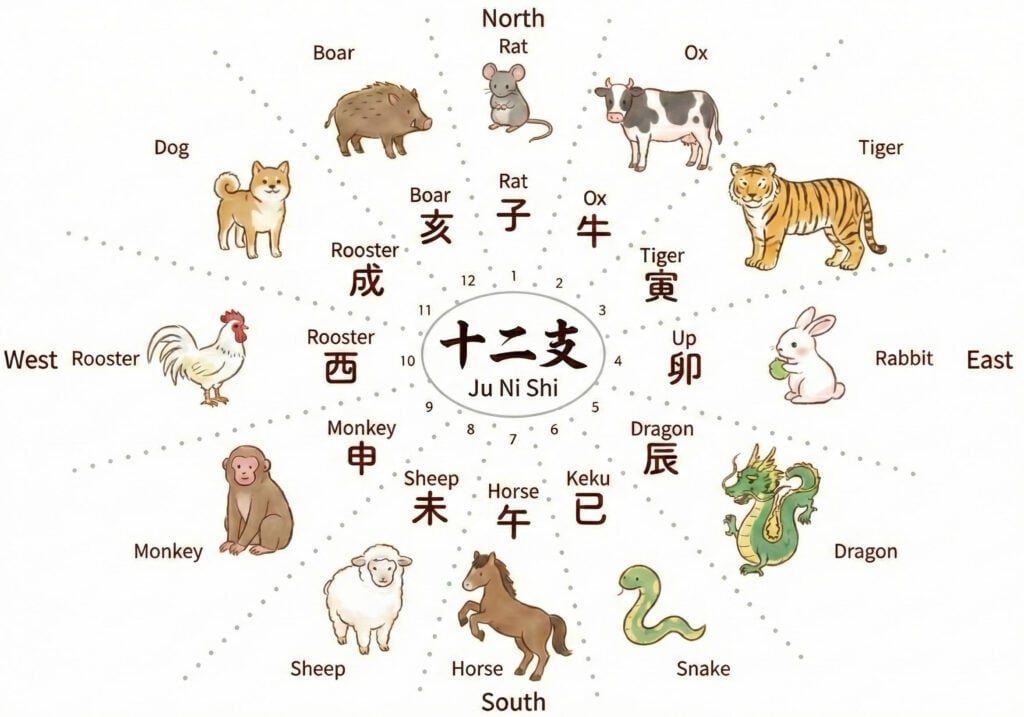
The Twelve Earthly Branches (Japanese: 十二支 jūnishi; Chinese: 地支 dìzhī) are a system of twelve ordered symbols. They correspond to the twelve-year orbital cycle of Jupiter and are associated with twelve zodiac animals, as well as directions, months, and two-hour time periods. In Japan, this system forms the basis of the Japanese zodiac (eto 干支).
| # | Branch | Animal | Direction | Time | Month | Recent Years | Traits |
|---|---|---|---|---|---|---|---|
| 1 | 子 (ne) | Rat (鼠 nezumi) | North | 23:00-01:00 | December | 2020, 2008, 1996 | Quick-witted, resourceful |
| 2 | 丑 (ushi) | Ox (牛 ushi) | NNE | 01:00-03:00 | January | 2021, 2009, 1997 | Diligent, dependable |
| 3 | 寅 (tora) | Tiger (虎 tora) | ENE | 03:00-05:00 | February | 2022, 2010, 1998 | Brave, confident |
| 4 | 卯 (u) | Rabbit (兎 usagi) | East | 05:00-07:00 | March | 2023, 2011, 1999 | Gentle, elegant |
| 5 | 辰 (tatsu) | Dragon (龍 ryū) | ESE | 07:00-09:00 | April | 2024, 2012, 2000 | Confident, ambitious |
| 6 | 巳 (mi) | Snake (蛇 hebi) | SSE | 09:00-11:00 | May | 2025, 2013, 2001 | Wise, intuitive |
| 7 | 午 (uma) | Horse (馬 uma) | South | 11:00-13:00 | June | 2026, 2014, 2002 | Energetic, free-spirited |
| 8 | 未 (hitsuji) | Goat (羊 hitsuji) | SSW | 13:00-15:00 | July | 2027, 2015, 2003 | Calm, gentle |
| 9 | 申 (saru) | Monkey (猿 saru) | WSW | 15:00-17:00 | August | 2028, 2016, 2004 | Clever, curious |
| 10 | 酉 (tori) | Rooster (鶏 niwatori) | West | 17:00-19:00 | September | 2029, 2017, 2005 | Observant, hardworking |
| 11 | 戌 (inu) | Dog (犬 inu) | WNW | 19:00-21:00 | October | 2030, 2018, 2006 | Loyal, honest |
| 12 | 亥 (i) | Boar (猪 inoshishi) | NNW | 21:00-23:00 | November | 2031, 2019, 2007 | Compassionate, generous |
The Twelve Earthly Branches are closely associated with directions in traditional East Asian cosmology. The four cardinal directions align with specific branches, while the intermediate directions correspond to the remaining branches:
The intermediate directions are: NNE (丑 Ox), ENE (寅 Tiger), ESE (辰 Dragon), SSE (巳 Snake), SSW (未 Goat), WSW (申 Monkey), WNW (戌 Dog), and NNW (亥 Boar).
The Sexagenary Cycle (Japanese: 干支 eto or kanshi; Chinese: 干支 gānzhī) is a 60-year cycle created by combining the Ten Heavenly Stems with the Twelve Earthly Branches. Since 10 and 12 have a least common multiple of 60, the cycle produces 60 unique combinations before repeating.
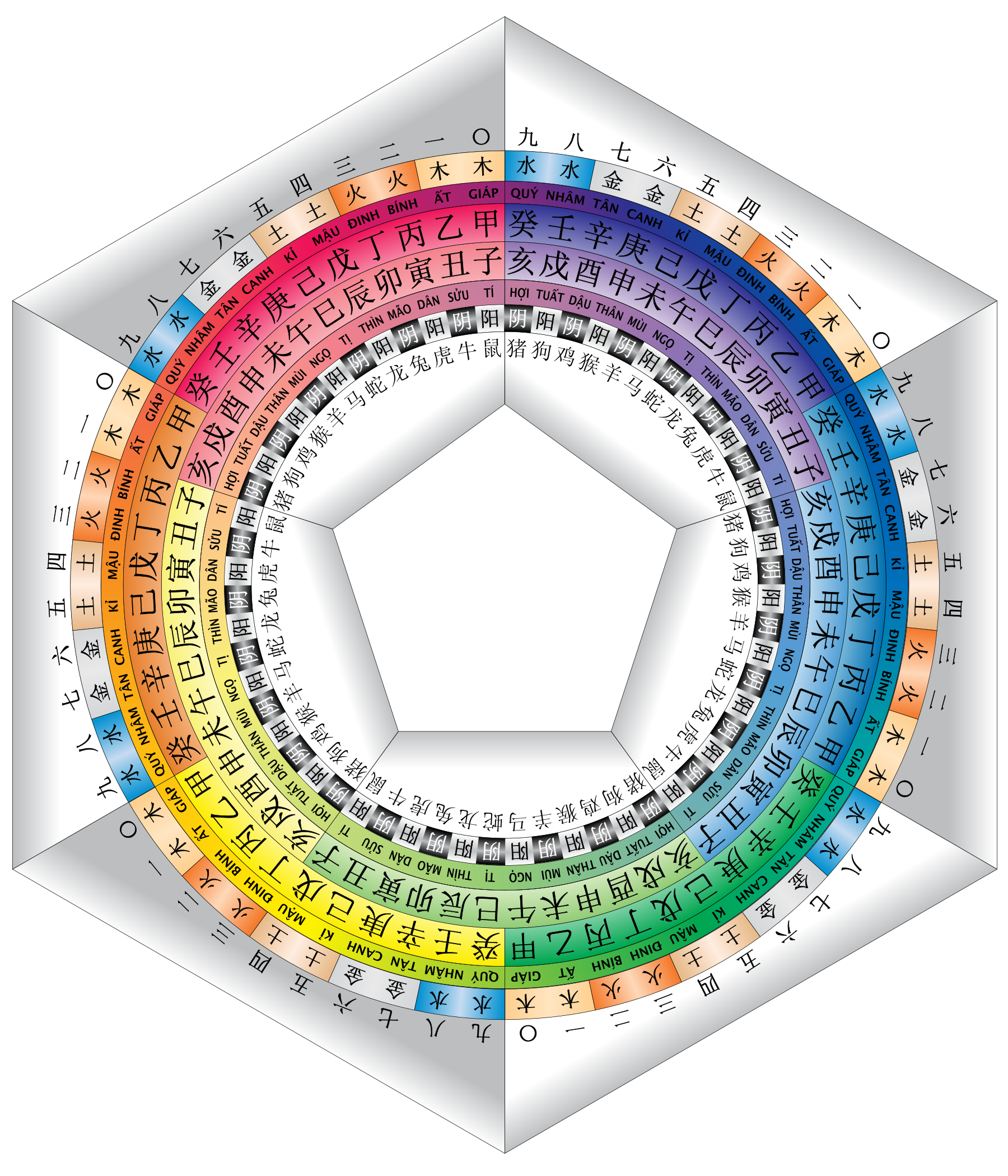
The Ten Heavenly Stems (Japanese: 十干 jikkan; Chinese: 天干 tiāngān) are an ancient ordinal system. They were originally the names of the ten days of the week.
Each stem is associated with one of the Five Elements and either Yin (陰) or Yang (陽). In Japanese, Yin is associated with “younger brother” (弟 to) and Yang with “elder brother” (兄 e), leading to the term eto (兄弟) for the calendar cycle.
Each year is designated by pairing one Heavenly Stem with one Earthly Branch. The stem and branch each advance by one for each year, creating 60 unique pairings before the cycle repeats.
| # | 干支 | Reading | Element-Animal | Recent Year |
|---|---|---|---|---|
| 1 | 甲子 | kinoe-ne | Wood Rat | 1984, 2044 |
| 2 | 乙丑 | kinoto-ushi | Wood Ox | 1985, 2045 |
| 3 | 丙寅 | hinoe-tora | Fire Tiger | 1986, 2046 |
| 4 | 丁卯 | hinoto-u | Fire Rabbit | 1987, 2047 |
| 5 | 戊辰 | tsuchinoe-tatsu | Earth Dragon | 1988, 2048 |
| 6 | 己巳 | tsuchinoto-mi | Earth Snake | 1989, 2049 |
| 7 | 庚午 | kanoe-uma | Metal Horse | 1990, 2050 |
| 8 | 辛未 | kanoto-hitsuji | Metal Goat | 1991, 2051 |
| 9 | 壬申 | mizunoe-saru | Water Monkey | 1992, 2052 |
| 10 | 癸酉 | mizunoto-tori | Water Rooster | 1993, 2053 |
| 11 | 甲戌 | kinoe-inu | Wood Dog | 1994, 2054 |
| 12 | 乙亥 | kinoto-i | Wood Boar | 1995, 2055 |
| 13 | 丙子 | hinoe-ne | Fire Rat | 1996, 2056 |
| 14 | 丁丑 | hinoto-ushi | Fire Ox | 1997, 2057 |
| 15 | 戊寅 | tsuchinoe-tora | Earth Tiger | 1998, 2058 |
| 16 | 己卯 | tsuchinoto-u | Earth Rabbit | 1999, 2059 |
| 17 | 庚辰 | kanoe-tatsu | Metal Dragon | 2000, 2060 |
| 18 | 辛巳 | kanoto-mi | Metal Snake | 2001, 2061 |
| 19 | 壬午 | mizunoe-uma | Water Horse | 2002, 2062 |
| 20 | 癸未 | mizunoto-hitsuji | Water Goat | 2003, 2063 |
| 21 | 甲申 | kinoe-saru | Wood Monkey | 2004, 2064 |
| 22 | 乙酉 | kinoto-tori | Wood Rooster | 2005, 2065 |
| 23 | 丙戌 | hinoe-inu | Fire Dog | 2006, 2066 |
| 24 | 丁亥 | hinoto-i | Fire Boar | 2007, 2067 |
| 25 | 戊子 | tsuchinoe-ne | Earth Rat | 2008, 2068 |
| 26 | 己丑 | tsuchinoto-ushi | Earth Ox | 2009, 2069 |
| 27 | 庚寅 | kanoe-tora | Metal Tiger | 2010, 2070 |
| 28 | 辛卯 | kanoto-u | Metal Rabbit | 2011, 2071 |
| 29 | 壬辰 | mizunoe-tatsu | Water Dragon | 2012, 2072 |
| 30 | 癸巳 | mizunoto-mi | Water Snake | 2013, 2073 |
| 31 | 甲午 | kinoe-uma | Wood Horse | 2014, 2074 |
| 32 | 乙未 | kinoto-hitsuji | Wood Goat | 2015, 2075 |
| 33 | 丙申 | hinoe-saru | Fire Monkey | 2016, 2076 |
| 34 | 丁酉 | hinoto-tori | Fire Rooster | 2017, 2077 |
| 35 | 戊戌 | tsuchinoe-inu | Earth Dog | 2018, 2078 |
| 36 | 己亥 | tsuchinoto-i | Earth Boar | 2019, 2079 |
| 37 | 庚子 | kanoe-ne | Metal Rat | 2020, 2080 |
| 38 | 辛丑 | kanoto-ushi | Metal Ox | 2021, 2081 |
| 39 | 壬寅 | mizunoe-tora | Water Tiger | 2022, 2082 |
| 40 | 癸卯 | mizunoto-u | Water Rabbit | 2023, 2083 |
| 41 | 甲辰 | kinoe-tatsu | Wood Dragon | 2024, 2084 |
| 42 | 乙巳 | kinoto-mi | Wood Snake | 2025, 2085 |
| 43 | 丙午 | hinoe-uma | Fire Horse | 2026, 2086 |
| 44 | 丁未 | hinoto-hitsuji | Fire Goat | 2027, 2087 |
| 45 | 戊申 | tsuchinoe-saru | Earth Monkey | 2028, 2088 |
| 46 | 己酉 | tsuchinoto-tori | Earth Rooster | 2029, 2089 |
| 47 | 庚戌 | kanoe-inu | Metal Dog | 2030, 2090 |
| 48 | 辛亥 | kanoto-i | Metal Boar | 2031, 2091 |
| 49 | 壬子 | mizunoe-ne | Water Rat | 2032, 2092 |
| 50 | 癸丑 | mizunoto-ushi | Water Ox | 2033, 2093 |
| 51 | 甲寅 | kinoe-tora | Wood Tiger | 2034, 2094 |
| 52 | 乙卯 | kinoto-u | Wood Rabbit | 2035, 2095 |
| 53 | 丙辰 | hinoe-tatsu | Fire Dragon | 2036, 2096 |
| 54 | 丁巳 | hinoto-mi | Fire Snake | 2037, 2097 |
| 55 | 戊午 | tsuchinoe-uma | Earth Horse | 2038, 2098 |
| 56 | 己未 | tsuchinoto-hitsuji | Earth Goat | 2039, 2099 |
| 57 | 庚申 | kanoe-saru | Metal Monkey | 2040, 2100 |
| 58 | 辛酉 | kanoto-tori | Metal Rooster | 2041, 2101 |
| 59 | 壬戌 | mizunoe-inu | Water Dog | 2042, 2102 |
| 60 | 癸亥 | mizunoto-i | Water Boar | 2043, 2103 |
The current 60-year cycle began in 1984 (甲子) and will end in 2043. The next cycle begins in 2044.
In Japan, the 60th birthday is especially significant because the person has completed one full sexagenary cycle and “returns” to the year sign of their birth. This milestone is traditionally celebrated with red clothing, symbolizing rebirth and a fresh start.
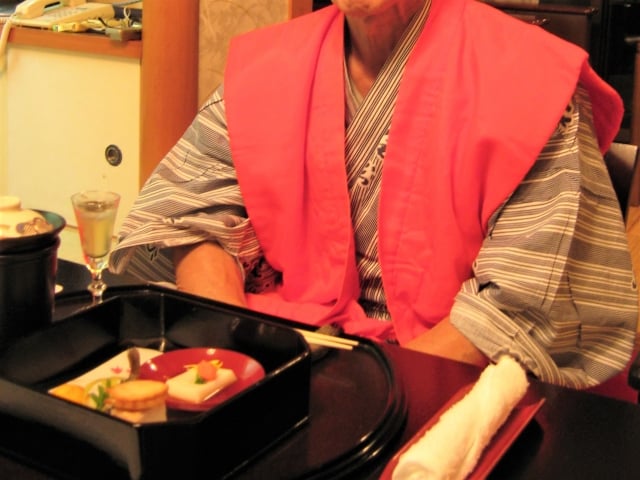
60th birthday celebration meal
Many historical events are named using the sexagenary cycle year in which they occurred:
The Five Elements (Japanese: 五行 gogyō; Chinese: 五行 wǔxíng) is a fivefold conceptual scheme used in traditional East Asian philosophy. Rather than static “elements,” they represent dynamic phases or transformations of energy and matter.
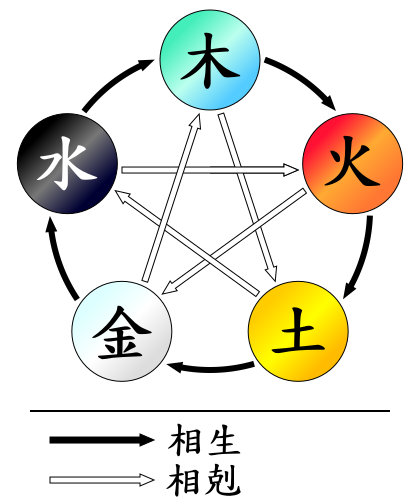
Benoît Stella alias User:BenduKiwi, CC BY-SA 3.0 <http://creativecommons.org/licenses/by-sa/3.0/>, via Wikimedia Commons
Each element generates or nurtures the next in a continuous cycle:
Each element controls or overcomes another:
The I Ching (易経 Ekikyō in Japanese; also known as the Book of Changes) is an ancient Chinese divination text and one of the oldest of the Chinese classics. It uses a system of 64 hexagrams—figures composed of six stacked horizontal lines, where each line is either Yang (solid) or Yin (broken).
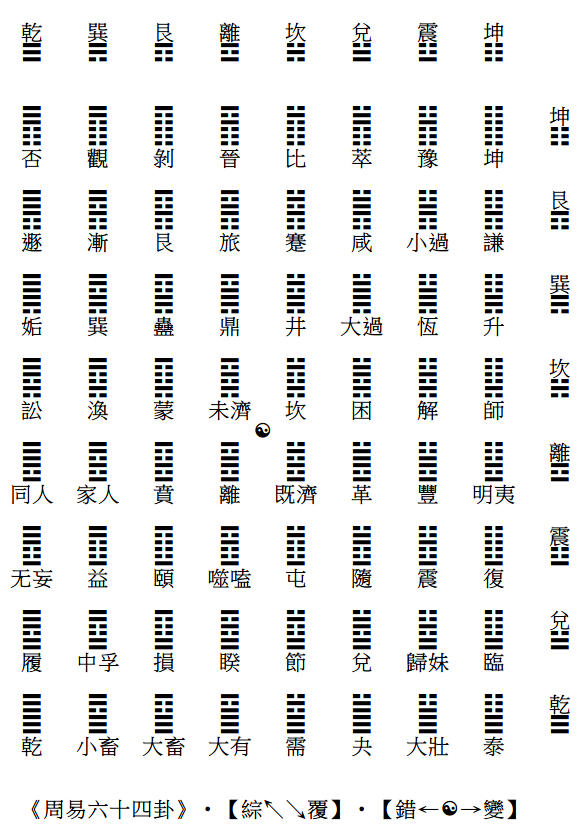
東岐明, CC BY-SA 4.0 <https://creativecommons.org/licenses/by-sa/4.0>, via Wikimedia Commons
Each hexagram is composed of two trigrams (三爻 sankō), three-line figures stacked one on top of the other:
The eight basic trigrams, each with three lines:
By combining two trigrams, 64 unique hexagrams are formed (8 × 8 = 64). Each hexagram has a name, judgment, and line texts accumulated over millennia.
| # | Hexagram | Japanese | English Name | Trigrams |
|---|---|---|---|---|
| 1 | 乾 | けん Ken | The Creative | Heaven / Heaven |
| 2 | 坤 | こん Kon | The Receptive | Earth / Earth |
| 3 | 屯 | ちゅん Chun | Difficulty at the Beginning | Water / Thunder |
| 4 | 蒙 | もう Mō | Youthful Folly | Mountain / Water |
| 5 | 需 | じゅ Ju | Waiting | Water / Heaven |
| 6 | 訟 | しょう Shō | Conflict | Heaven / Water |
| 7 | 師 | し Shi | The Army | Earth / Water |
| 8 | 比 | ひ Hi | Holding Together | Water / Earth |
| 9 | 小畜 | しょうちく Shōchiku | Small Accumulating | Wind / Heaven |
| 10 | 履 | り Ri | Treading | Heaven / Lake |
| 11 | 泰 | たい Tai | Peace | Earth / Heaven |
| 12 | 否 | ひ Hi | Standstill | Heaven / Earth |
| 13 | 同人 | どうじん Dōjin | Fellowship | Heaven / Fire |
| 14 | 大有 | たいゆう Taiyū | Great Possession | Fire / Heaven |
| 15 | 謙 | けん Ken | Modesty | Earth / Mountain |
| 16 | 豫 | よ Yo | Enthusiasm | Thunder / Earth |
| 17 | 隨 | ずい Zui | Following | Lake / Thunder |
| 18 | 蠱 | こ Ko | Work on the Decayed | Mountain / Wind |
| 19 | 臨 | りん Rin | Approach | Earth / Lake |
| 20 | 観 | かん Kan | Contemplation | Wind / Earth |
| 21 | 噬嗑 | ぜいこう Zeikō | Biting Through | Fire / Thunder |
| 22 | 賁 | ひ Hi | Grace | Mountain / Fire |
| 23 | 剥 | はく Haku | Splitting Apart | Mountain / Earth |
| 24 | 復 | ふく Fuku | Return | Earth / Thunder |
| 25 | 无妄 | むぼう Mubō | Innocence | Heaven / Thunder |
| 26 | 大畜 | たいちく Taichiku | Great Accumulating | Mountain / Heaven |
| 27 | 頤 | い I | Nourishment | Mountain / Thunder |
| 28 | 大過 | たいか Taika | Great Exceeding | Lake / Wind |
| 29 | 坎 | かん Kan | The Abysmal | Water / Water |
| 30 | 離 | り Ri | The Clinging | Fire / Fire |
| 31 | 咸 | かん Kan | Influence | Lake / Mountain |
| 32 | 恒 | こう Kō | Duration | Thunder / Wind |
| 33 | 遯 | とん Ton | Retreat | Heaven / Mountain |
| 34 | 大壮 | たいそう Taisō | Great Power | Thunder / Heaven |
| 35 | 晋 | しん Shin | Progress | Fire / Earth |
| 36 | 明夷 | めいい Meii | Darkening of the Light | Earth / Fire |
| 37 | 家人 | かじん Kajin | The Family | Wind / Fire |
| 38 | 睽 | けい Kei | Opposition | Fire / Lake |
| 39 | 蹇 | けん Ken | Obstruction | Water / Mountain |
| 40 | 解 | かい Kai | Deliverance | Thunder / Water |
| 41 | 損 | そん Son | Decrease | Mountain / Lake |
| 42 | 益 | えき Eki | Increase | Wind / Thunder |
| 43 | 夬 | かい Kai | Breakthrough | Lake / Heaven |
| 44 | 姤 | こう Kō | Coming to Meet | Heaven / Wind |
| 45 | 萃 | すい Sui | Gathering Together | Lake / Earth |
| 46 | 升 | しょう Shō | Pushing Upward | Earth / Wind |
| 47 | 困 | こん Kon | Oppression | Lake / Water |
| 48 | 井 | せい Sei | The Well | Water / Wind |
| 49 | 革 | かく Kaku | Revolution | Lake / Fire |
| 50 | 鼎 | てい Tei | The Cauldron | Fire / Wind |
| 51 | 震 | しん Shin | The Arousing | Thunder / Thunder |
| 52 | 艮 | ごん Gon | Keeping Still | Mountain / Mountain |
| 53 | 漸 | ぜん Zen | Development | Wind / Mountain |
| 54 | 帰妹 | きまい Kimai | The Marrying Maiden | Thunder / Lake |
| 55 | 豊 | ほう Hō | Abundance | Thunder / Fire |
| 56 | 旅 | りょ Ryo | The Wanderer | Fire / Mountain |
| 57 | 巽 | そん Son | The Gentle | Wind / Wind |
| 58 | 兌 | だ Da | The Joyous | Lake / Lake |
| 59 | 渙 | かん Kan | Dispersion | Wind / Water |
| 60 | 節 | せつ Setsu | Limitation | Water / Lake |
| 61 | 中孚 | ちゅうふ Chūfu | Inner Truth | Wind / Lake |
| 62 | 小過 | しょうか Shōka | Small Exceeding | Thunder / Mountain |
| 63 | 既済 | きせい Kisei | After Completion | Water / Fire |
| 64 | 未済 | びせい Bisei | Before Completion | Fire / Water |
Several kanji used in Japanese names derive meaning from their association with I Ching hexagrams. When a hexagram is referenced in a kanji’s meaning, it connects the character to this ancient wisdom tradition, adding layers of philosophical and cosmological significance.
Share on your favorite






Or copy the link
Sort by: Most Relevant
Sorts names by how closely they match your search meaning. Names containing more kanji that match your search terms appear higher in the results.
Sort by: Most Kanji Variations
Sorts names by how many different kanji spellings they have. In general, names with more variants tend to be more familiar and widespread in Japan (with some exceptions).
Sort by: Most Viewed
Sorts names by page views on this site. Views reflect global traffic (including Japan), so this does not represent popularity among Japanese people only. A high view count does not necessarily mean the name is famous in Japan.
What is Hiragana?
Hiragana is one of the two Japanese syllabaries. Each character represents a sound (mora), not a meaning. It is used for native words, grammatical particles, verb/adjective endings (okurigana), and to show pronunciation above kanji (furigana). It developed from cursive forms of kanji.
What is Katakana?
Katakana is one of the two Japanese syllabaries. Each character represents a sound (mora), not a meaning. It is mainly used to write foreign words and names, loanwords, onomatopoeia, and for emphasis.
What is a Kanji Idea?
Kanji are Chinese characters used in Japanese writing. Unlike katakana and hiragana, each kanji character carries its own meaning.
When we convert your name into kanji, we select characters whose sounds match the Japanese pronunciation of your name, while also considering the meaning of each character. The result is a unique combination of kanji that both sounds like your name and carries meaningful symbolism.
We refresh the kanji combination each time you visit, so you can discover different options. If you find one you like, save it to your favorites!
What are English Syllables?
A syllable is a unit of pronunciation in English — it’s the beat you hear when you say a word.
Here are a few quick examples:
cat = 1 syllable
ba-by = 2 syllables
beau-ti-ful = 3 syllables
On this site, English Syllables show how a name naturally breaks into sounds when spoken in English. This helps you understand how English speakers naturally say the name and where they pause between sounds.
What are Japanese Morae?
A mora (plural: morae, Japanese: 拍 Haku) is the basic unit of sound in Japanese — think of it as one rhythmic “beat” when speaking.
Here are a few quick examples:
あ (a) = 1 mora
あい (a-i) = 2 morae
きょう (kyo-u) = 2 morae
On this site, Japanese Morae show how many “beats” a name has in Japanese. Most Japanese names have about 2–4 morae, which affects how natural and rhythmic the name sounds to native speakers.
This helps you see how the name fits into the natural rhythm of Japanese speech.
What is English Transcription?
“English transcription” (romanization) is the romanized form of a Japanese name, intended to reproduce its pronunciation as closely as possible. It is also useful for searching names on this site.
Japanese-Style Nicknames
In Japan, nicknames are used to express familiarity and affection. Typical features include:
Shortened forms: Names are often shortened for closeness, e.g., “Yuki” from “Yukiko” or “Taka” from “Takashi”.
Suffixes: Terms like “-chan” (often for girls, also for young children) and “-kun” (often for boys) are used among family and close friends. Among very close adults, “-chan” may still be used. More details
Use & context: Nicknames are informal—common among friends, family, or close colleagues—and are not suitable for formal or professional settings. Their use implies a certain degree of intimacy.
Long vowels: The long vowel mark “chōonpu” (ー) extends the preceding vowel. For example, “あーちゃん” (A-chan) lengthens the “あ” sound.
Households
Sorts surnames by the estimated number of Japanese households that use them. More households generally indicates a more common or well-known surname.
About our last-name data

Success
Migration completed successfully!