 My Favorites
Share on your favorite
Or copy the link
Below are navigation links that will take you to the main text and navigation menus.
26,551 first names, 70,620 last names, 333,585 kanji variations.
one of the best Japanese name search tools for your baby!

Image by: City hunter comic 1 ©Tsukasa Hojo/ Shueisha Inc,
Contents
City Hunter is a manga series written and illustrated by Tsukasa Hojo. The story follows Ryo Saeba, a ‘Sweeper’ which is a private detective who works to rid crime in Shinjuku, Tokyo. After the death of his former partner, Ryo decides to take care of his late partner’s sister Kaori, who soon became his new partner. May it be, guarding or assassinating, the city hunters are not afraid to dirty their hands to protect the city!

Image by: City hunter movie official website ©Tsukasa Hojo/NSP/City hunter movie production committee
The Japanese title is also called ‘City Hunter シティーハンター’ and it is written in English and Katakana. Both the words ‘City’ and ‘Hunter’ are written in Katakana because they are English words.
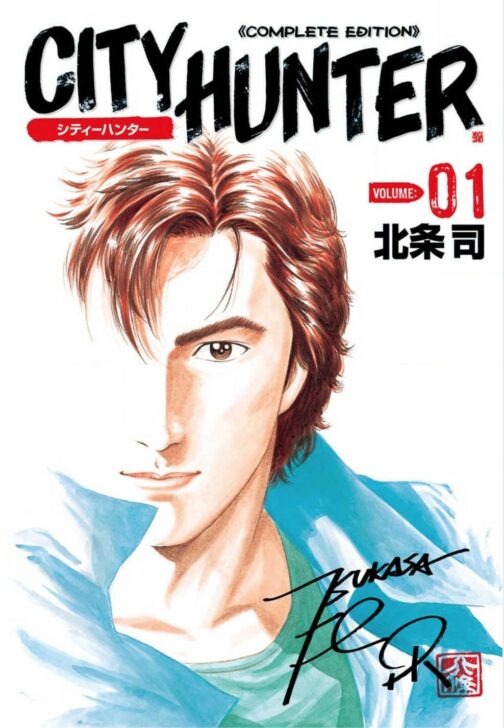
Image by: City hunter comic 1 ©Tsukasa Hojo/ Shueisha Inc,
In Japanese culture, names have significant meanings that are supposed to represent you as a person. Names can be expressed in hiragana, katakana, and kanji. Let’s find out the meanings of some names of characters in City hunter.
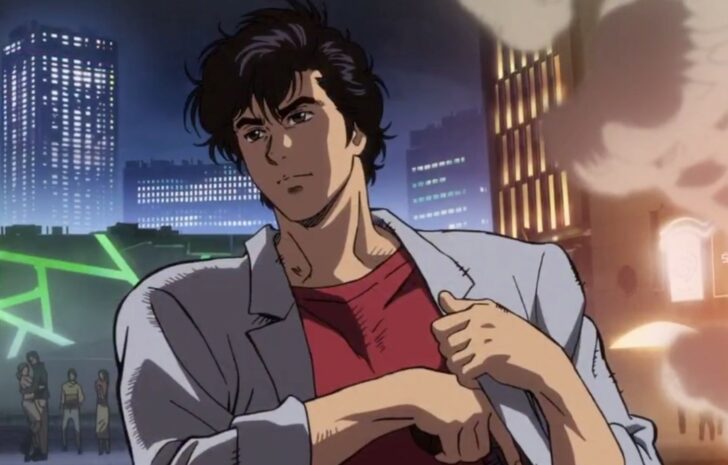
Image by: City hunter Shinjuku private eyes ©Tsukasa Hojo/NSP/City hunter movie production committee
Ryo, the main character of this series is a skilled gunman. He formed the City hunter group with his former Partner to fight against crime. ‘Sae’(冴) means clear, ‘Ba’(羽) is a feather, and ‘Ryo’(獠) means to hunt in the dark.

Image by: City hunter Shinjuku private eyes ©Tsukasa Hojo/NSP/City hunter movie production committee
Kaori took over her brother’s position as Ryo’s partner. She is often mistaken as a boy from her appearance and tomboyish behavior. ‘Maki’(槇) is a type of tree, ‘Mura’(村) is a village, and ‘Kaori’(香) means fragrance.

Image by: City hunter Shinjuku private eyes ©Tsukasa Hojo/NSP/City hunter movie production committee
Saeko works for the Tokyo police force and is also a client of the city hunters. Ryo believes he is cursed by Saeko because her cases often lead to a dangerous situation. ‘No’(野) is a field, ‘Gami’(上) means up, ‘Sae’(冴) is clear and ‘Ko’(子) is a child and a common ending for girls names.

Image by: City hunter Shinjuku private eyes ©Tsukasa Hojo/NSP/City hunter movie production committee
Umibozu, Ryo’s friend and rival, is a professionally trained soldier who works as a sweeper. His name Umibozu is a monster from Japanese folklore. ‘Umi’(海), is an ocean and ‘Bozu’(坊主) is a priest. Another meaning of Bozu is a shaved-headed person, and it is also used to call a young boy.

Image by: City hunter Shinjuku private eyes ©Tsukasa Hojo/NSP/City hunter movie production committee
Last but not least, Umibozu’s wife and Partner, Miki. As an orphan, she was both raised and taught combat by Umibozu. She later grows into a very skilled soldier who knows how to deal with all kinds of weapons. Miki is also a very loyal person who won’t hesitate to help those in need, which makes her a great sweeper. ‘Mi’(美) means beauty and ‘Ki’(樹) is a tree.
Here are some useful phrases from City Hunter that will help you along with your Japanese studies!
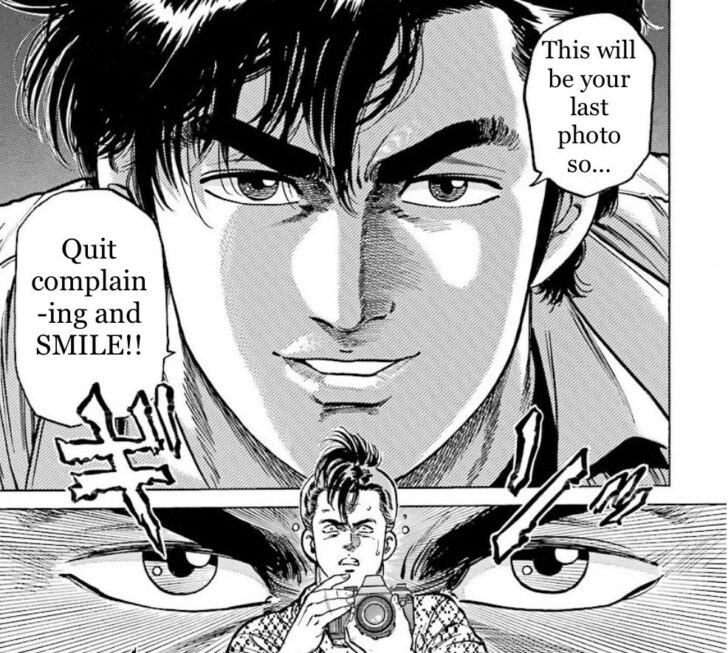
Image by: City hunter Comic 12 Ep 109 ©Tsukasa Hojo, Shueisha Inc,
‘Koitsu’ means this, ‘Omae’ is an informal way to call a person, and ‘Saigo’ is the last. ‘Kinen’(記念) means memorial and ‘Satsuei’(撮影) is a photoshoot. ‘Gata gata’ is one of the Japanese onomatopoeia which has several meanings such as, wobbly, uneven, and shiver. ‘Iu'() means to say and ‘Gata gata iu’(ガタガタ言う) means to grumble. ‘Iwazuni'(言わずに) is another way of saying ‘Iwanaide'(言わないで) which means don’t say. ‘Warau’(笑う) means to laugh and ‘Warae’(笑え) is to order someone to laugh.
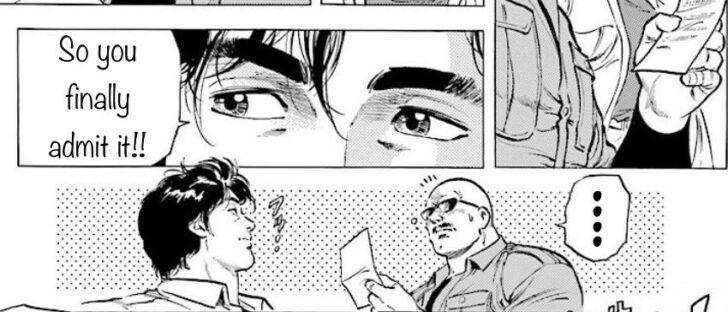
Image by: City hunter Comic 17 Ep 163 ©Tsukasa Hojo, Shueisha Inc,
‘Tou tou’(とうとう= 到頭) means finally but since it is written with two kanji’s each of them has different meanings. ‘Tou’(到) means coming to and ‘Tou’(頭) is head. ‘Hakujou’(白状) means to confess and ‘Shitana’(したな) is said when you ask someone if they did it.
 Share
Share Share on your favorite






Or copy the link
Sort by: Most Relevant
Sorts names by how closely they match your search meaning. Names containing more kanji that match your search terms appear higher in the results.
Sort by: Most Kanji Variations
Sorts names by how many different kanji spellings they have. In general, names with more variants tend to be more familiar and widespread in Japan (with some exceptions).
Sort by: Most Viewed
Sorts names by page views on this site. Views reflect global traffic (including Japan), so this does not represent popularity among Japanese people only. A high view count does not necessarily mean the name is famous in Japan.
What is Hiragana?
Hiragana is one of the two Japanese syllabaries. Each character represents a sound (mora), not a meaning. It is used for native words, grammatical particles, verb/adjective endings (okurigana), and to show pronunciation above kanji (furigana). It developed from cursive forms of kanji.
What is Katakana?
Katakana is one of the two Japanese syllabaries. Each character represents a sound (mora), not a meaning. It is mainly used to write foreign words and names, loanwords, onomatopoeia, and for emphasis.
What is a Kanji Idea?
Kanji are Chinese characters used in Japanese writing. Unlike katakana and hiragana, each kanji character carries its own meaning.
When we convert your name into kanji, we select characters whose sounds match the Japanese pronunciation of your name, while also considering the meaning of each character. The result is a unique combination of kanji that both sounds like your name and carries meaningful symbolism.
We refresh the kanji combination each time you visit, so you can discover different options. If you find one you like, save it to your favorites!
What are English Syllables?
A syllable is a unit of pronunciation in English — it’s the beat you hear when you say a word.
Here are a few quick examples:
cat = 1 syllable
ba-by = 2 syllables
beau-ti-ful = 3 syllables
On this site, English Syllables show how a name naturally breaks into sounds when spoken in English. This helps you understand how English speakers naturally say the name and where they pause between sounds.
What are Japanese Morae?
A mora (plural: morae, Japanese: 拍 Haku) is the basic unit of sound in Japanese — think of it as one rhythmic “beat” when speaking.
Here are a few quick examples:
あ (a) = 1 mora
あい (a-i) = 2 morae
きょう (kyo-u) = 2 morae
On this site, Japanese Morae show how many “beats” a name has in Japanese. Most Japanese names have about 2–4 morae, which affects how natural and rhythmic the name sounds to native speakers.
This helps you see how the name fits into the natural rhythm of Japanese speech.
What is English Transcription?
“English transcription” (romanization) is the romanized form of a Japanese name, intended to reproduce its pronunciation as closely as possible. It is also useful for searching names on this site.
Japanese-Style Nicknames
In Japan, nicknames are used to express familiarity and affection. Typical features include:
Shortened forms: Names are often shortened for closeness, e.g., “Yuki” from “Yukiko” or “Taka” from “Takashi”.
Suffixes: Terms like “-chan” (often for girls, also for young children) and “-kun” (often for boys) are used among family and close friends. Among very close adults, “-chan” may still be used. More details
Use & context: Nicknames are informal—common among friends, family, or close colleagues—and are not suitable for formal or professional settings. Their use implies a certain degree of intimacy.
Long vowels: The long vowel mark “chōonpu” (ー) extends the preceding vowel. For example, “あーちゃん” (A-chan) lengthens the “あ” sound.
Households
Sorts surnames by the estimated number of Japanese households that use them. More households generally indicates a more common or well-known surname.
About our last-name data

Success
Migration completed successfully!