 My Favorites
Share on your favorite
Or copy the link
Below are navigation links that will take you to the main text and navigation menus.
26,551 first names, 70,620 last names, 333,585 kanji variations.
one of the best Japanese name search tools for your baby!

Image by: Gurren Lagann Comic 1 ©GAINAX, KADOKAWA
Contents
The story takes place in a fictional future where human beings were forced to live in underground villages completely cut out from the surface world. Under the threat of earthquakes and roof fall, they had to keep on digging to survive. One day a young boy named Simon discovers a glowing drill shaped key and a mysterious Gunmen (robot). Suddenly the ceiling crashed and a huge Gunmen started to attack them. With the help of a girl who appeared from the surface world, Simon activates the robot with the drill shaped key and defeats the Gunmen. Curious Simon and Kamina headed to the surface world and learned that the world was taken over by the Spiral King Lordgenome.

Image by: Gurren Lagann official website ©GAINAX, Kazuki Nakajima, ANIPLEX, TV Tokyo,
The Japanese title is called ‘天元突破グレンラガン’ (Tengen Toppa Guren Ragan). ‘Tengen’(天元) means the origin of life and ‘Toppa’(突破) is to breakthrough. ‘Guren Ragan’ is the name of the machine with a huge drill.

Image by: Gurren Lagann Comic 1 ©GAINAX, KADOKAWA
In Japanese culture, names have significant meanings that are supposed to represent you as a person. Names can be expressed in hiragana, katakana, and kanji. Let’s find out the meanings of some names of characters from Team Gurren!

Image by: Gurren Lagann Ep 17 ©GAINAX, Kazuki Nakajima, ANIPLEX, TV Tokyo,
Simon, the main character of this exciting series grew up in an underground village, digging towards his dream to be on the surface one day. The origin of his name Simon came from the word ‘Shimo’(下) which means down.

Image by: Gurren Lagann Ep 16 ©GAINAX, Kazuki Nakajima, ANIPLEX, TV Tokyo,
Kamina is a charismatic young man from the underground village. He is the leader of team Gurenn who fights against Lordgenome. The origin of his name Kamina is from the word ‘Kami’(上) which means up.

Image by: Gurren Lagann Ep 17 ©GAINAX, Kazuki Nakajima, ANIPLEX, TV Tokyo,
Nia, the curious daughter of the Spiral King, Lordgenome. She grew up in the kingdom on the surface world and spent almost all her time there. So, she is curious about the world and the underground village just like how they are curious about the surface. The origin of her name is ‘Near’ which in Japanese is ‘Chikai’(近い).

Image by: Gurren Lagann Ep 16 ©GAINAX, Kazuki Nakajima, ANIPLEX, TV Tokyo,
Yoko came from the underground village next to Simon and Kamina’s village. She is a skilled sniper in team Gurenn. Yoko’s name came from the word ‘Yoko’(横) which means ‘Next To’. This is a common Japanese girl’s name and there are many other ways to write Yoko.

Image by: Gurren Lagann Ep 24 ©GAINAX, Kazuki Nakajima, ANIPLEX, TV Tokyo,
Kittan, leader of the hunter group ‘Black Siblings’ is an energetic and aggressive young man. The origin of his name came from the word ‘Tanki’(短気) which means short-tempered.

Image by: Gurren Lagann Ep 16 ©GAINAX, Kazuki Nakajima, ANIPLEX, TV Tokyo,
Gimmy is one of the ace pilots in the Grapearl squad who later joins team Gurren to support Simon. His name Gimmy is derived from the word ‘Migi’(右) which means the right.

Image by: Gurren Lagann Ep 16 ©GAINAX, Kazuki Nakajima, ANIPLEX, TV Tokyo,
Gimmy’s younger sister Darry is also one of the ace pilots in the Grapearl squad. The twins have a special bonding and are always together even when they join team Dai Gurren. Darry’s name is derived from the word ‘Hidari’(左) which means the left.
Here are some useful phrases from Gurren Lagann that will help you along with your Japanese studies!
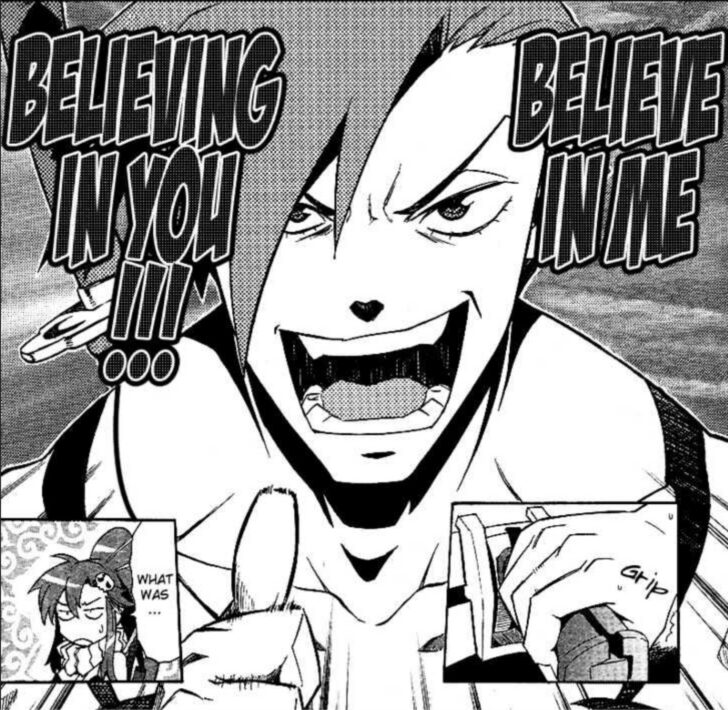
Image by: Gurren Lagann Comic 1 Ep 2©GAINAX, KADOKAWA
‘Omae’(お前) is a way to call a person but it is rude to use it against strangers or people you are not so close to. ‘Ore’() is a way boys call themselves.
‘Shinjiru’(信じる) is to trust and ‘Shinjiro’(信じろ) is to tell a person to trust!
 Share
Share Share on your favorite






Or copy the link
Sort by: Most Relevant
Sorts names by how closely they match your search meaning. Names containing more kanji that match your search terms appear higher in the results.
Sort by: Most Kanji Variations
Sorts names by how many different kanji spellings they have. In general, names with more variants tend to be more familiar and widespread in Japan (with some exceptions).
Sort by: Most Viewed
Sorts names by page views on this site. Views reflect global traffic (including Japan), so this does not represent popularity among Japanese people only. A high view count does not necessarily mean the name is famous in Japan.
What is Hiragana?
Hiragana is one of the two Japanese syllabaries. Each character represents a sound (mora), not a meaning. It is used for native words, grammatical particles, verb/adjective endings (okurigana), and to show pronunciation above kanji (furigana). It developed from cursive forms of kanji.
What is Katakana?
Katakana is one of the two Japanese syllabaries. Each character represents a sound (mora), not a meaning. It is mainly used to write foreign words and names, loanwords, onomatopoeia, and for emphasis.
What is a Kanji Idea?
Kanji are Chinese characters used in Japanese writing. Unlike katakana and hiragana, each kanji character carries its own meaning.
When we convert your name into kanji, we select characters whose sounds match the Japanese pronunciation of your name, while also considering the meaning of each character. The result is a unique combination of kanji that both sounds like your name and carries meaningful symbolism.
We refresh the kanji combination each time you visit, so you can discover different options. If you find one you like, save it to your favorites!
What are English Syllables?
A syllable is a unit of pronunciation in English — it’s the beat you hear when you say a word.
Here are a few quick examples:
cat = 1 syllable
ba-by = 2 syllables
beau-ti-ful = 3 syllables
On this site, English Syllables show how a name naturally breaks into sounds when spoken in English. This helps you understand how English speakers naturally say the name and where they pause between sounds.
What are Japanese Morae?
A mora (plural: morae, Japanese: 拍 Haku) is the basic unit of sound in Japanese — think of it as one rhythmic “beat” when speaking.
Here are a few quick examples:
あ (a) = 1 mora
あい (a-i) = 2 morae
きょう (kyo-u) = 2 morae
On this site, Japanese Morae show how many “beats” a name has in Japanese. Most Japanese names have about 2–4 morae, which affects how natural and rhythmic the name sounds to native speakers.
This helps you see how the name fits into the natural rhythm of Japanese speech.
What is English Transcription?
“English transcription” (romanization) is the romanized form of a Japanese name, intended to reproduce its pronunciation as closely as possible. It is also useful for searching names on this site.
Japanese-Style Nicknames
In Japan, nicknames are used to express familiarity and affection. Typical features include:
Shortened forms: Names are often shortened for closeness, e.g., “Yuki” from “Yukiko” or “Taka” from “Takashi”.
Suffixes: Terms like “-chan” (often for girls, also for young children) and “-kun” (often for boys) are used among family and close friends. Among very close adults, “-chan” may still be used. More details
Use & context: Nicknames are informal—common among friends, family, or close colleagues—and are not suitable for formal or professional settings. Their use implies a certain degree of intimacy.
Long vowels: The long vowel mark “chōonpu” (ー) extends the preceding vowel. For example, “あーちゃん” (A-chan) lengthens the “あ” sound.
Households
Sorts surnames by the estimated number of Japanese households that use them. More households generally indicates a more common or well-known surname.
About our last-name data

Success
Migration completed successfully!